Lola Odelola shared the news on Bluesky last week. I’m using my blog and web presence to signal boost it.
Long story short: There currently is no Baseline or caniuse for accessibility. The Accessibility Compat Data (ACD) project aims to fix this longstanding platform gap, and you can help fund it.
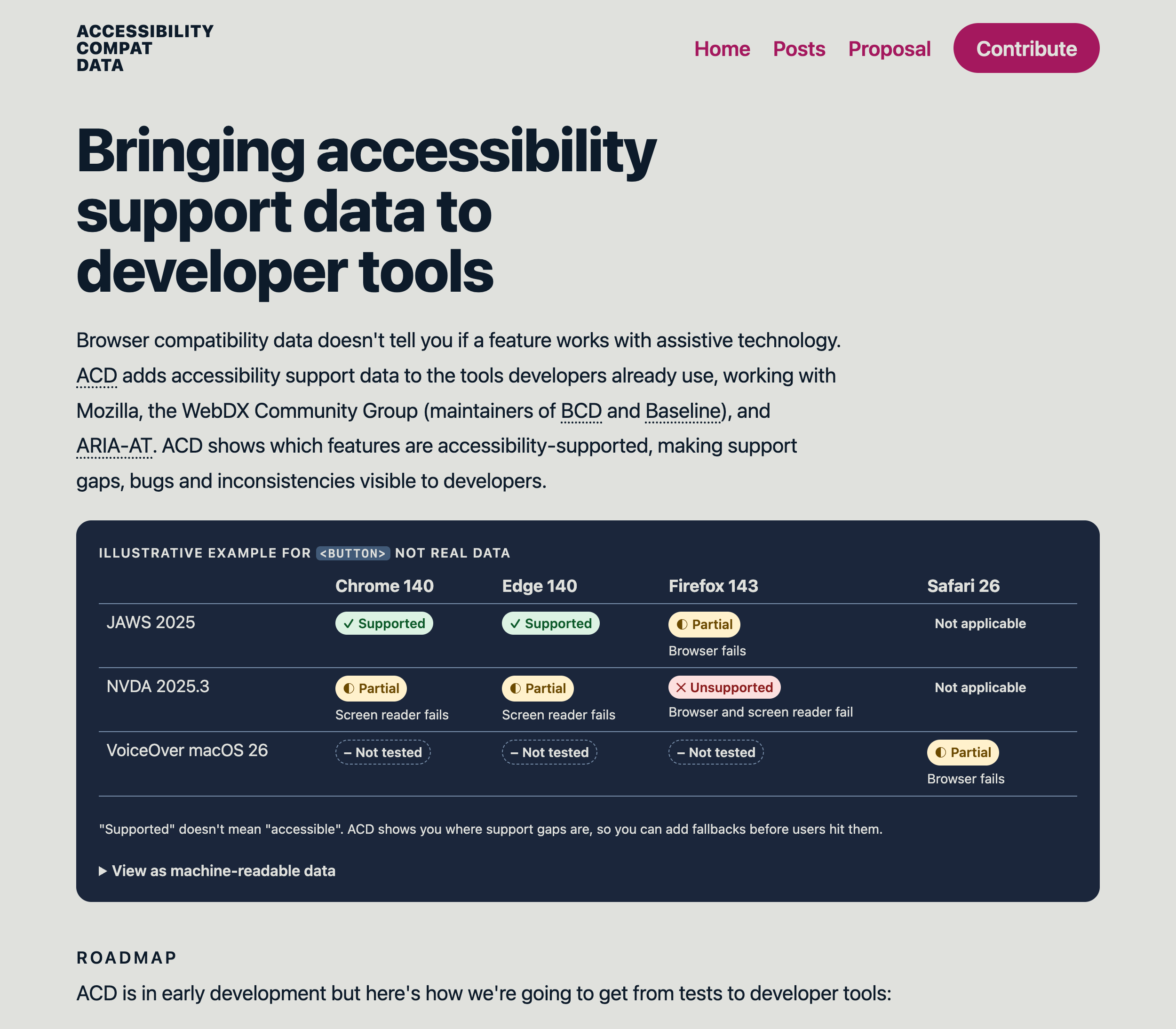
Assistive technology support is different
The equivalent of the web standards movement has never happened for assistive technology. Determining support in the actual means navigating a tangled mess of multiple assistive technologies, operating systems, and browsers and all their constituent quirks and bugs. It is the exact opposite of how developers think about support for web platform features.
Learning about this nuance is one of the many unnecessary “death by a thousand cuts” points of friction non-accessibility specialists encounter when trying to do the right thing. It also breaks my heart every time I witness it happen.
Encoding bias
Additionally, the lack of this machine-parsable support information can also create some nasty outcomes when LLMs enter the picture.
For example: I was tasked with assisting a project that had instruction files that compelled using both the latest and greatest web technologies, and also some rudimentary concessions towards accessibility.
These instructions created an outcome where the LLM did exactly what it was set to do. aria-details was used in great confidence, distributed across the entire experience. For those unaware, aria-details does not yet work in the actual.
Now think about all the other more established bugs and support gaps you might be aware of, and how those are getting unknowingly propagated at scale. Correlation is not causation, but I do think LLM-powered coding is in its current state is making things worse when it comes to web accessibility.
Here, we must be sure to center the human-facing impact this all conspires to create. Accessibility is—after all—ultimately for people.
Better infrastructure
Capturing assistive technology support data in a machine-parsable format helps to set guardrails against negative outcomes. This is done in the same way that Baseline information helps steer other project support requirements.
This is also huge in terms of developer experience, as it is far easier to plug this sort of information into a system than expecting people to perform rigorous manual evaluation. It also helps normalize the practice as something a well-built project does.
ACD is a much-needed piece of web infrastructure, vital to making digital accessibility efforts both successful and sustainable. Its supporting project goals and planning are also open and transparent, available on GitHub.
It also needs funding to succeed.
Pessimism of the intelligence, optimism of the will
While emotionally I feel like companies like Google, Apple, and Microsoft should have been providing resources for this for decades now, intellectually I know that their priorities lie elsewhere.
It is a very spirit-of-the-web act to support ACD as a groundswell, bottom-up effort. I hope you’ll join me in helping to fund it.
Further reading
- RFC: Defining Support Status in ACD Accessibility Compat Data
- The idea of Accessibility Compat Data Mitsue Links
- Baseline Does Not Really Cover Baseline Support Adrian Roselli